


How to Choose a Corporate Event Planning Company: 12 Questions Every Company Should Ask Before Hiring


Hiring a corporate event planning company is a significant decision.
The right partner can help your organization manage strategy, budgets, vendors, production, executives, attendee logistics, and hundreds of details behind the scenes.
The wrong fit can create more work for the internal team you were trying to support in the first place.
That is especially true as company events become more complex.
A leadership meeting may involve executive schedules, travel, audiovisual production, catering, transportation, speakers, branded materials, and detailed timelines.
A conference may involve hundreds of attendees, multiple rooms, registration, production teams, sponsors, hotels, and several days of programming.
Even an employee appreciation event can quickly grow beyond what an internal team reasonably has time to manage.
So how do you choose a corporate event planning company that can actually handle what your organization needs?
The answer is not simply comparing portfolios or asking for pricing.
Before hiring a corporate event planner, companies should understand how the planning team approaches strategy, budgets, communication, vendors, production, logistics, and live execution.
Here are 12 questions worth asking before making the decision.
Why Choosing the Right Corporate Event Planning Company Matters
Corporate event planning is different from simply organizing a gathering.
The event may represent your organization in front of employees, clients, executives, investors, partners, or industry leaders.
That means the planning company is not only managing logistics.
They are helping execute an experience connected to your brand.
A strong planning partner should understand both sides of that responsibility.
They need to know how to build a detailed production timeline and manage vendor arrivals.
But they should also understand why the event exists in the first place.
If you are still determining what level of outside support your organization needs, our guide to Meetings & Events Management and what companies should expect from a full-service M&E partner explains how strategy, production, logistics, and attendee experience can work together under one coordinated plan.
1. What Types of Corporate Events Do You Specialize In?
Not every event planning company approaches corporate events the same way.
Some planners specialize primarily in social celebrations and occasionally manage business events.
Others focus on meetings, conferences, employee events, executive programs, or complex corporate experiences.
Neither approach is inherently wrong.
What matters is whether their experience matches your event.
Ask about their experience with events such as:
conferences
leadership meetings
executive gatherings
sales meetings
employee appreciation events
awards programs
corporate holiday events
client experiences
product launches
retreats
multi-day programs
You are looking for more than a list of events they have attended or assisted with.
Ask what they were actually responsible for.
Did they manage the budget?
Did they source vendors?
Did they oversee audiovisual production?
Did they coordinate speakers?
Did they manage transportation?
Were they responsible for the entire program or one portion of it?
The complexity of the role matters just as much as the event type.
2. How Do You Approach Event Strategy and Business Objectives?
One of the best ways to evaluate a corporate event planning company is to listen to the questions they ask before discussing venues, décor, or entertainment.
A strategic planner should want to understand:
Why is the organization hosting the event?
Who is attending?
What should attendees learn, feel, or do afterward?
What priorities matter most to leadership?
What does success look like?
Which parts of the event deserve the greatest investment?
A leadership retreat designed to improve executive alignment should not be planned the same way as an employee appreciation celebration.
A client event designed to strengthen relationships has different priorities from a sales kickoff designed to motivate and educate.
Event strategy should influence the venue, agenda, food and beverage, production, entertainment, guest flow, branding, and budget.
Our Corporate Event Planning Guide explores this broader planning process, including why defining objectives early can make nearly every later decision easier.
3. Who Will Actually Manage Our Event?
This is one of the most important questions companies forget to ask.
The person leading the initial consultation may not necessarily be the person managing the event.
Before signing a contract, understand:
Who is your primary point of contact?
Who builds the planning timeline?
Who attends vendor meetings?
Who manages the event budget?
Who creates the run-of-show?
Who will be physically present on-site?
Will additional team members be assigned?
Who has decision-making authority during the event?
You should know who you will be working with throughout the process.
This becomes particularly important for complex events involving multiple departments, executives, venues, and vendors.
A clear communication structure can prevent confusion later.
4. How Will You Work With Our Internal Team?
This question deserves special attention.
Hiring an outside event planning company does not mean the internal team disappears from the process.
The strongest relationships are partnerships.
Your employees understand the organization, leadership, brand, culture, and internal stakeholders.
The planning company understands how to translate those priorities into an event.
Before hiring, determine how responsibilities will be divided.
Ask:
What information do you need from our team?
Who will manage approvals?
How often will we meet?
How will decisions be documented?
Who communicates with executives?
Who communicates with vendors?
How will changes be approved?
What responsibilities remain with us?
This is particularly important for companies currently handling internal event planning.
If employees are already managing venues, vendors, budgets, transportation, and production on top of their normal roles, the goal of hiring outside support should be to reduce that workload, not add another layer of management.
A strong partner should make the planning process clearer.

5. How Do You Build and Manage the Event Budget?
Corporate event budgets can become complicated quickly.
A proposal that initially appears reasonable may change significantly once production, labor, transportation, service charges, rentals, and other requirements are included.
Ask the planning company how they approach:
initial budget development
vendor estimates
contingency funds
service charges
taxes
gratuities
production expenses
transportation
rentals
staffing
budget updates
final reconciliation
Also ask how transparent financial reporting will be.
Will your team receive an updated budget throughout the planning process?
Will vendor estimates be visible?
Who approves expenses before they are committed?
How are changes documented?
A good planner is not simply trying to make an event cheaper.
They should help the organization determine where its resources will create the greatest impact.
Our Corporate Event Budget Breakdown provides a closer look at the categories companies should consider when developing an event budget.

6. How Do You Source and Manage Venues and Vendors?
Corporate events often require a significant vendor network.
Depending on the event, that may include:
venues
hotels
caterers
audiovisual companies
staging companies
transportation providers
entertainers
photographers
videographers
rental companies
florists
security
registration teams
signage and printing companies
Ask how the planner selects vendors.
Are recommendations based on existing relationships?
Budget?
Event requirements?
Previous performance?
Location?
Production needs?
A good event planning company should be able to explain why a vendor is appropriate for your specific event.
Venue selection should be approached the same way.
A beautiful venue does not automatically make it a good corporate venue.
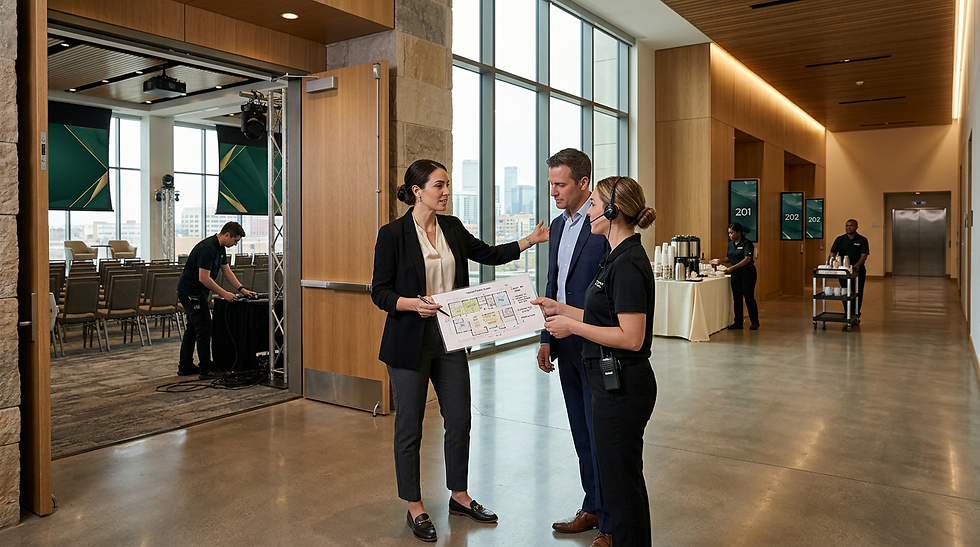
Professional planners should consider guest flow, registration, breakout rooms, AV capabilities, Wi-Fi, parking, transportation, load-in access, catering, staging, storage, accessibility, weather contingencies, and event timing before recommending a space.
7. How Do You Handle AV, Staging, and Event Production?
For many corporate events, this is where the complexity increases dramatically.
Conferences, executive meetings, awards programs, sales meetings, and leadership events may require:
microphones
presentation screens
LED walls
lighting
staging
video playback
teleprompters
confidence monitors
recording
livestreaming
walk-in music
speaker rehearsals
show calling
technical cues
Ask whether the event planner manages production directly or coordinates with a dedicated AV partner.
More importantly, ask how production is integrated into the overall event plan.
The AV team should not be working from one timeline while catering, speakers, transportation, and the planning team are working from another.
Production should connect to the master run-of-show.
The attendee may never see that coordination.
They simply experience an event that feels professional.

8. Can You Manage Executives, Speakers, and VIP Guests?
High-level corporate events often involve people with limited availability and complex schedules.
Executives and speakers may require:
airport transportation
hotel coordination
detailed arrival instructions
green rooms
rehearsals
presentation deadlines
stage cues
security
hospitality
departure transportation
Ask how the planning company manages these details.
Who communicates with the speaker?
Who confirms arrival?
Who handles last-minute presentation changes?
Who makes sure the executive is backstage at the correct time?
Who adjusts the program if someone is running late?
The more visible the event, the more important this coordination becomes.
9. How Do You Manage Registration, Travel, and the Attendee Experience?
A corporate event begins before attendees reach the ballroom.
Their experience may begin with the invitation, registration process, or travel arrangements.
Ask how the planning team approaches:
invitations
registration
confirmation emails
event websites
hotel room blocks
transportation
parking
badges
check-in
directional signage
accessibility
hospitality
guest questions
The best event planners look for friction.
Where might guests become confused?
Where could lines form?
What happens if transportation is late?
Can people easily find breakout rooms?
Is there a clear arrival process?
Our Corporate Event Planning Checklist covers several of these details that companies commonly overlook during the early stages of planning.

10. How Do You Build the Run-of-Show and Manage the Event On-Site?
A corporate event timeline is rarely enough.
Complex programs need a detailed run-of-show.
This document may include:
venue access
vendor arrivals
room setup
registration
executive arrivals
speaker rehearsals
lighting cues
music cues
presentations
video playback
meal service
awards
entertainment
transportation departures
room transitions
breakdown
Ask who creates this document and who maintains it during the event.
Then ask what the planning company actually manages on-site.
Will they oversee vendor arrivals?
Registration?
AV?
Catering?
Speakers?
Transportation?
Schedule changes?
Guest concerns?
Breakdown?
You should understand what “on-site management” means before assuming every planner defines it the same way.
11. How Do You Handle Last-Minute Changes and Problems?
Something will change.
It may be small.
It may not be.
A speaker misses a flight.
Weather changes.
A vendor is late.
A presentation file is replaced.
Transportation is delayed.
Attendance is higher than expected.
An executive meeting runs long.
The question is not whether every possible problem can be prevented.
The question is whether the event team is prepared to respond without transferring the stress to the client or the guests.
Ask prospective planning companies about contingency planning.
How do they communicate urgent decisions?
Who has authority on-site?
How are backup plans developed?
What happens if the original timeline no longer works?
You are not looking for a planner who claims nothing ever goes wrong.
You are looking for one who understands how to manage the unexpected professionally.

12. How Are Fees, Approvals, and Communication Structured?
Before hiring any corporate event planning company, understand exactly how the business relationship works.
Ask about:
planning fees
retainers
payment schedules
reimbursable expenses
travel
vendor payments
additional staffing
overtime
production fees
change orders
cancellation policies
You should also understand how approvals are documented.
Corporate planning often involves multiple stakeholders.
One person may approve the budget.
Another may approve branding.
Another may make executive decisions.
Clear approval systems help prevent confusion and unnecessary delays.
The strongest partnerships establish expectations before planning begins.
What Should a Full-Service Corporate Event Planning Partner Feel Like to Work With?
After asking all 12 questions, there is another consideration that is harder to put on a spreadsheet:
Does this company make the project feel more manageable?
The right partner should bring structure.
Communication should become clearer.
Decisions should become easier.
The internal team should understand what happens next.
Leadership should know where the project stands.
Vendors should know what is expected.
The planning company should feel like an extension of the organization rather than another vendor the organization has to manage.
That is one of the biggest differences between basic coordination and full-service Meetings & Events management.
Red Flags to Watch for When Hiring a Corporate Event Planner
A polished website or beautiful portfolio does not necessarily tell you how a company operates.
Pay attention if:
responsibilities are vague
the planner cannot clearly explain who manages the project
budgeting processes are unclear
communication expectations are not established
production is treated as an afterthought
vendor recommendations are made without understanding event requirements
no contingency planning is discussed
“on-site management” is poorly defined
the planner asks very little about the organization's objectives
pricing is difficult to understand
None of these automatically means the company is wrong for your event.
But they deserve additional questions before signing.
When Should You Hire a Corporate Event Planning Company?
Not every company event requires outside support.
A small team lunch or straightforward internal gathering may be perfectly manageable internally.
Professional planning becomes much more valuable when:
multiple vendors are involved
executives or VIP guests are attending
significant AV or production is required
attendees are traveling
transportation is involved
the event spans multiple days
several internal departments are involved
the company has no dedicated event team
the event carries significant reputational importance
employees are spending excessive time managing logistics
One useful question is:
What work is our internal team giving up in order to plan this event?
If employees are spending weeks researching venues, comparing vendors, managing production, building transportation schedules, tracking guest lists, and coordinating hundreds of details, the real cost of internal planning may be much greater than it appears.
Our guide on how hiring a corporate event planning company can save companies time and money explores that calculation in greater detail.
Choosing a Corporate Event Planning Company in Denver and Colorado
Colorado offers an enormous variety of corporate event environments.
Downtown Denver hotels.
Conference centers.
Mountain resorts.
Private estates.
Restaurants.
Executive retreat properties.
Large-scale event venues.
But Colorado also creates unique logistical considerations.
Weather.
Mountain transportation.
Guest travel.
Parking.
Elevation.
Seasonal availability.
Venue access.
Production requirements.
For companies planning events in Denver or elsewhere in Colorado, working with an experienced local partner can simplify both the planning process and the event itself.
Envy Event Planning provides corporate event planning services in Denver and throughout Colorado, including strategy, budgeting, vendor management, production oversight, executive logistics, attendee experience, and on-site event management.
Final Thoughts
Choosing a corporate event planning company should not come down to who has the prettiest portfolio.
The right partner should understand what your organization is trying to accomplish and have the systems, experience, communication, and operational capability to execute it.
Ask questions.
Understand responsibilities.
Clarify budgets.
Discuss production.
Talk about contingency plans.
Learn exactly who will be managing the event when the doors open.
The goal is not simply to hire someone who can plan an event.
It is to find a partner who can help your organization create the experience you intended while allowing your internal team to remain focused on the people and business behind it.
Ready to Plan Your Next Corporate Event?
If your company is planning a conference, leadership meeting, employee event, executive gathering, client experience, or other corporate program in Denver or elsewhere in Colorado, Envy Event Planning can help manage the strategy, budget, vendors, production, logistics, and execution from beginning to end.


